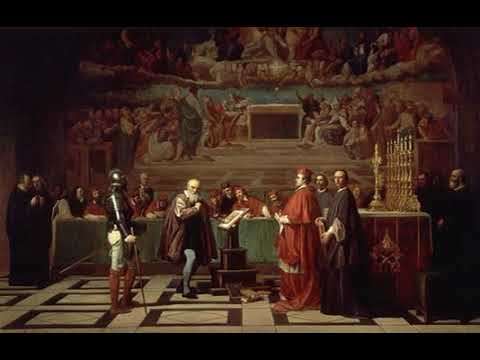
This is an audio version of the Wikipedia Article: https://en.wikipedia.org/wiki/Inquisi... 00:02:11 1 Definition and purpose 00:04:50 2 Origin 00:06:06 3 Medieval Inquisition 00:08:34 4 Early Modern European history 00:09:06 4.1 Witch-trials 00:13:30 4.2 Spanish Inquisition 00:16:50 4.3 Inquisition in the Spanish overseas empire 00:17:46 4.4 Portuguese Inquisition 00:21:07 4.5 Roman Inquisition 00:23:57 5 Ending of the Inquisition in the 19th and 20th centuries 00:25:42 6 Statistics 00:27:15 7 Appearance in popular media 00:30:01 8 See also 00:30:38 8.1 Documents and works 00:30:56 8.2 Notable inquisitors 00:31:16 8.3 Notable cases 00:31:43 8.4 Repentance Listening is a more natural way of learning, when compared to reading. Written language only began at around 3200 BC, but spoken language has existed long ago. Learning by listening is a great way to: - increases imagination and understanding - improves your listening skills - improves your own spoken accent - learn while on the move - reduce eye strain Now learn the vast amount of general knowledge available on Wikipedia through audio (audio article). You could even learn subconsciously by playing the audio while you are sleeping! If you are planning to listen a lot, you could try using a bone conduction headphone, or a standard speaker instead of an earphone. Listen on Google Assistant through Extra Audio: https://assistant.google.com/services... Other Wikipedia audio articles at: https://www.youtube.com/results?searc... Upload your own Wikipedia articles through: https://github.com/nodef/wikipedia-tts Speaking Rate: 0.8670531392426125 Voice name: en-US-Wavenet-A "I cannot teach anybody anything, I can only make them think." - Socrates SUMMARY ======= The Inquisition was a group of institutions within the government system of the Catholic Church whose aim was to combat heresy. It started in 12th-century France to combat religious dissent, in particular the Cathars and the Waldensians. Other groups investigated later included the Spiritual Franciscans, the Hussites (followers of Jan Hus) and the Beguines. Beginning in the 1250s, inquisitors were generally chosen from members of the Dominican Order, replacing the earlier practice of using local clergy as judges. The term Medieval Inquisition covers these courts up to mid-15th century. During the Late Middle Ages and the early Renaissance, the concept and scope of the Inquisition significantly expanded in response to the Protestant Reformation and the Catholic Counter-Reformation. It expanded to other European countries, resulting in the Spanish Inquisition and Portuguese Inquisition. The Spanish and Portuguese operated inquisitorial courts throughout their empires in Africa, Asia, and the Americas (resulting in the Peruvian Inquisition and Mexican Inquisition). The Spanish and Portuguese inquisitions focused particularly on the issue of Jewish anusim and Muslim converts to Catholicism, partly because these minority groups were more numerous in Spain and Portugal than in many other parts of Europe, and partly because they were often considered suspect due to the assumption that they had secretly reverted to their previous religions. With the exception of the Papal States, the institution of the Inquisition was abolished in the early 19th century, after the Napoleonic Wars in Europe and the Spanish American wars of independence in the Americas. The institution survived as part of the Roman Curia, but in 1908 it was renamed the "Supreme Sacred Congregation of the Holy Office". In 1965 it became the Congregation for the Doctrine of the Faith.
Inquisition | Wikipedia audio article - YouTube |
| 0 Likes | 0 Dislikes |
| 4 views views | 283 followers |
| Education Creative Commons Attribution licence (reuse allowed) | Upload TimePublished on 26 Mar 2019 |


Không có nhận xét nào:
Đăng nhận xét